 EN
EN
 AR
AR
 BG
BG
 HR
HR
 CS
CS
 DA
DA
 NL
NL
 FI
FI
 FR
FR
 DE
DE
 EL
EL
 IT
IT
 JA
JA
 KO
KO
 NO
NO
 PL
PL
 PT
PT
 RO
RO
 RU
RU
 ES
ES
 SV
SV
 TL
TL
 IW
IW
 ID
ID
 SR
SR
 SK
SK
 UK
UK
 VI
VI
 SQ
SQ
 HU
HU
 TH
TH
 TR
TR
 MS
MS
 GA
GA
 CY
CY
 IS
IS
 HY
HY
 AZ
AZ
 KA
KA

Why Do Organizations Prefer Stainless Steel Mess Tins?
When organizations—whether military units, outdoor education programs, corporate catering teams, or humanitarian relief agencies—evaluate food service equipment, they consistently gravitate toward one particular solution: the stainless steel mess tin. This preference is not arbitrary. It reflects decades of operational experience, stringent hygiene requirements, and the undeniable performance advantages that this category of equipment delivers across demanding environments. Understanding why organizations choose a stainless steel mess tin over alternatives requires a close look at the structural, hygienic, logistical, and economic factors that drive procurement decisions in B2B and institutional contexts.
From military field operations to scout camps, disaster relief missions to corporate retreats, the stainless steel mess tin has proven itself as a reliable, multi-purpose food container that outperforms plastic, aluminum, and coated alternatives in nearly every measurable category. Organizations that manage large fleets of field equipment understand that the initial investment in quality materials pays dividends in reduced replacement cycles, lower contamination risk, and stronger operational continuity. This article examines the core reasons why institutional and organizational buyers consistently prefer the stainless steel mess tin for their field and facility needs.
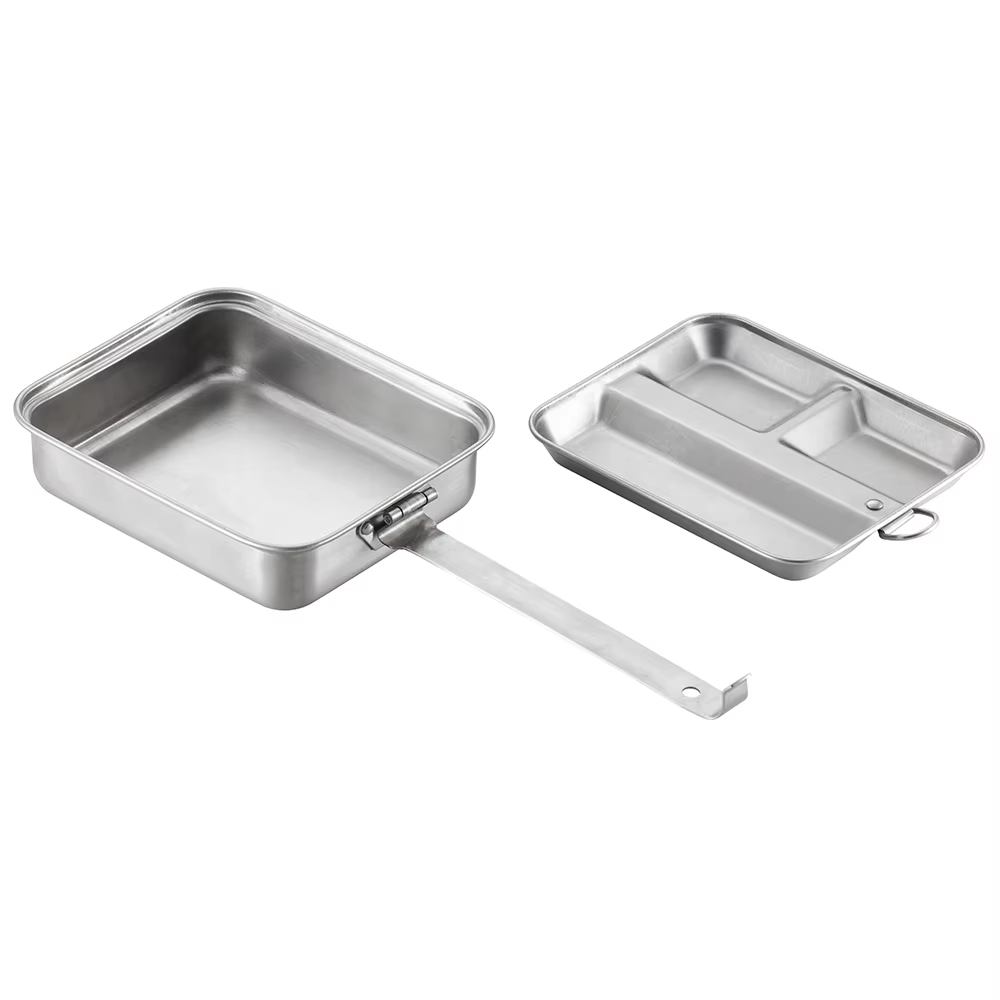
Durability and Structural Integrity Under Operational Stress
Built to Withstand Repeated Heavy Use
One of the most immediate reasons organizations favor a stainless steel mess tin is its remarkable structural durability. Unlike plastic containers that crack under pressure or aluminum units that dent and deform, stainless steel maintains its shape and function even under significant mechanical stress. In military or field environments, equipment is routinely dropped, stacked under heavy loads, and subjected to extreme temperature swings—conditions that would compromise lesser materials.
The metallurgical properties of stainless steel give it a unique balance of rigidity and slight flexibility, meaning it can absorb impacts without fracturing. This is critical for organizations that issue equipment en masse and cannot afford to replace containers every few months. A single stainless steel mess tin that endures five or ten years of service represents a fundamentally better procurement decision than a plastic alternative replaced annually.
For logistics and procurement officers, this durability translates directly into total cost of ownership calculations. The longer a piece of equipment lasts without degradation, the more favorable the per-use cost becomes. This is a compelling financial argument that resonates strongly with organizational decision-makers managing tight budgets and large inventories.
Resistance to Environmental Extremes
The stainless steel mess tin excels in environments that would rapidly degrade other materials. Whether exposed to sub-zero temperatures in alpine operations or intense heat in desert deployments, stainless steel retains its structural and functional integrity. It does not become brittle in cold conditions and does not warp or leach harmful compounds under high heat—a critical consideration when containers are used directly over open flames or camp stoves.
Organizations operating in humid coastal environments or tropical climates also benefit from stainless steel's corrosion resistance. The chromium content in the alloy forms a passive oxide layer that prevents rust from developing even with prolonged exposure to moisture, saltwater spray, or acidic food residues. This resistance is not a coating that wears off over time; it is an inherent metallurgical property of the material itself.
For humanitarian organizations deploying in monsoon regions or maritime rescue operations, this corrosion resistance is not merely a convenience—it is a functional necessity that ensures equipment remains serviceable throughout extended deployment cycles without specialized maintenance.
Hygiene Standards and Food Safety Compliance
Non-Porous Surface and Contamination Control
Hygiene is a non-negotiable priority for any organization responsible for feeding people in institutional or field settings. The stainless steel mess tin meets this requirement with a non-porous, smooth internal surface that does not harbor bacteria, mold, or food residue in microscopic surface irregularities. Unlike plastic containers, which develop micro-scratches over time that create reservoirs for bacterial growth, stainless steel remains hygienic even after thousands of wash cycles.
This non-porous quality also means the stainless steel mess tin does not absorb odors or flavors from previous meals. In field environments where a single container may be used for multiple meal types throughout a day, this prevents cross-contamination of flavor and eliminates the persistent odor problem that plagues plastic and some coated aluminum alternatives.
For catering organizations and military kitchens operating under strict food safety audits, the ability to demonstrate contamination control is directly tied to regulatory compliance. A stainless steel mess tin is far easier to validate under food safety inspection frameworks precisely because its surface properties are consistent, measurable, and well-documented in food-grade materials standards.
Chemical Inertness and Food-Grade Safety
Organizational buyers responsible for health and safety are increasingly scrutinizing the chemical interactions between food containers and their contents. The stainless steel mess tin is chemically inert with respect to virtually all common food and beverage types, including acidic foods such as tomato-based sauces, citrus beverages, and fermented products. It does not leach heavy metals, plasticizers, or coating particles into food—a concern that has driven many organizations away from coated aluminum and BPA-associated plastics.
Food-grade stainless steel alloys comply with international food safety standards, making them an accepted material in commercial food service, military procurement, and humanitarian supply chains worldwide. Organizations that must demonstrate due diligence in their food safety programs find that specifying a stainless steel mess tin simplifies compliance documentation significantly.
This chemical safety profile is especially important in contexts where vulnerable populations are served, such as disaster relief operations, refugee camp feeding programs, or youth outdoor education. In these settings, the risk calculus around material safety carries significant ethical and legal weight, reinforcing the institutional preference for stainless steel.
Versatility Across Operational Scenarios
Multi-Function Use in Field and Facility Settings
The stainless steel mess tin is not simply a passive container—it is a multi-function tool that adapts to the operational context. Its direct heat compatibility allows it to serve as a cooking vessel over camp stoves or open fires, as a boiling container for water purification, and as a standard serving and eating vessel. This versatility reduces the total number of items personnel must carry or organizations must stock, which has significant logistical advantages.
Military organizations in particular value this multi-functionality because it reduces pack weight and equipment complexity without sacrificing capability. A single stainless steel mess tin that can cook, serve, and store food replaces several single-purpose items, which simplifies supply chains and reduces per-person kit weight. This is a concrete operational advantage that procurement teams quantify when comparing equipment options.
Beyond military use, outdoor education organizations, survival training programs, and bushcraft schools choose the stainless steel mess tin precisely because it teaches participants to accomplish multiple tasks with minimal equipment. This pedagogical value aligns with the broader educational goals of self-reliance and resourcefulness that these programs are designed to develop.
Compatibility With Standard Cleaning and Sterilization Processes
Organizations that manage large quantities of shared equipment must be able to clean and sterilize that equipment efficiently using industrial processes. The stainless steel mess tin is fully compatible with commercial dishwashers, autoclave sterilization, boiling water disinfection, and chemical sanitization protocols. It does not degrade under the high temperatures or chemical concentrations used in institutional cleaning settings.
In contrast, plastic containers may warp or become discolored in high-temperature dishwashers, while coated aluminum containers can lose their protective layer under aggressive chemical cleaning. These material failures create both a functional problem and a food safety concern, neither of which applies to the stainless steel mess tin.
For large organizations running centralized kitchen and equipment management operations, the ability to process hundreds or thousands of items through standard industrial cleaning equipment without material degradation is a significant operational efficiency gain. It eliminates the need for specialized cleaning protocols and reduces labor costs associated with manual cleaning of damaged containers.
Economic and Logistical Advantages for Bulk Procurement
Total Cost of Ownership Over Equipment Lifecycle
While the unit cost of a stainless steel mess tin may be higher than a plastic or thin aluminum equivalent at the point of purchase, organizational buyers with experience in large-scale procurement understand that initial unit cost is only one component of total cost of ownership. When durability, replacement frequency, maintenance requirements, and failure rates are factored in, the stainless steel mess tin consistently delivers a more favorable economic outcome over a five-to-ten-year horizon.
Procurement teams that have operated both plastic and stainless steel inventories report substantially lower annual replacement rates for stainless steel units. In institutional settings where equipment loss and damage rates follow predictable statistical patterns, even a modest improvement in equipment longevity compounds into significant cost savings across a large fleet. This is particularly relevant for defense and government agencies operating under multi-year budget frameworks.
The residual value of a stainless steel mess tin also differs meaningfully from plastic alternatives. At end of service life, stainless steel has inherent scrap value and is fully recyclable, aligning with organizational sustainability commitments and potentially contributing to materials recovery programs. Plastic containers, by contrast, often end as landfill waste with no residual value.
Standardization and Supply Chain Simplification
Organizations managing complex, multi-site operations benefit from standardizing on a single, well-specified equipment item. The stainless steel mess tin lends itself well to standardization because its material properties, dimensions, and functional characteristics can be precisely specified in procurement documents and consistently verified upon delivery. This is more difficult to achieve with coated or composite materials, where quality variation and coating integrity are harder to assess at scale.
Standardization also simplifies inventory management, spare parts logistics, and cross-site equipment sharing. When every unit in a fleet is the same stainless steel mess tin with the same specifications, equipment from one deployment can be seamlessly transferred to another without compatibility concerns. This interoperability is a genuine logistical advantage for organizations with multiple concurrent operational deployments.
For procurement officers drafting tender specifications, the stainless steel mess tin is a well-established category with clear international standards, making it straightforward to write verifiable technical specifications that ensure supplier compliance. This transparency reduces procurement risk and simplifies quality assurance processes throughout the supply chain.
Sustainability and Organizational Responsibility
Alignment With Environmental Policy Commitments
Increasingly, organizations are held accountable not only for operational performance but also for their environmental footprint. The stainless steel mess tin aligns well with environmental responsibility frameworks because it is a durable, long-life product made from a fully recyclable material. Organizations that have committed to reducing single-use plastics or minimizing waste find that equipping personnel with stainless steel mess tins is a concrete, visible demonstration of that commitment.
The longevity of a stainless steel mess tin means that fewer units need to be manufactured and disposed of over any given time period, reducing the total material and energy input required to maintain a functional equipment fleet. This lifecycle advantage is increasingly recognized in sustainability assessments and organizational environmental reporting frameworks.
For organizations that communicate their sustainability credentials to stakeholders, donors, or regulatory bodies, the choice of a stainless steel mess tin as standard issue equipment sends a clear and credible signal about long-term thinking and responsible resource stewardship. It is a small but symbolically meaningful choice that reinforces broader organizational values.
Reduced Dependency on Single-Use and Disposable Alternatives
In emergency response and humanitarian contexts, organizations sometimes face pressure to use disposable food containers for speed and convenience. However, extended deployments quickly reveal the logistical and environmental costs of this approach—disposables must be continuously restocked, generate substantial waste in resource-constrained environments, and create sanitation challenges when waste management infrastructure is absent.
The stainless steel mess tin provides a permanent, reusable alternative that eliminates ongoing disposable resupply requirements once the initial equipment issue is complete. For operations that extend over weeks or months, this represents a meaningful reduction in the logistical tail and a significant improvement in waste management outcomes at the deployment site.
Organizations that have made the transition from disposable or short-life containers to stainless steel mess tins report not only environmental benefits but also operational improvements, including more consistent meal service, fewer supply chain disruptions related to consumable restocking, and higher satisfaction among personnel who appreciate having reliable, quality equipment.
FAQ
Why is a stainless steel mess tin preferred over aluminum in military procurement?
Stainless steel offers superior corrosion resistance, does not react with acidic foods, and maintains structural integrity under repeated heavy use better than standard aluminum. While aluminum is lighter, organizational buyers in military contexts often prioritize longevity, hygiene, and multi-decade service life over marginal weight savings, making the stainless steel mess tin the preferred specification in most modern military procurement frameworks.
Can a stainless steel mess tin be used directly over an open flame?
Yes. One of the defining functional advantages of the stainless steel mess tin is its direct heat compatibility. It can be placed over camp stoves, gas burners, and open fires without warping, releasing harmful compounds, or damaging the vessel. This makes it a genuinely multi-function tool rather than a passive container, which is a key reason field-oriented organizations specify it as standard personal equipment.
How does the stainless steel mess tin support food safety compliance in institutional settings?
The non-porous surface of a stainless steel mess tin does not harbor bacteria or absorb food residues, making it far easier to clean and sterilize to food safety standards than plastic or coated alternatives. Its chemical inertness means it does not leach harmful substances into food, and it is compatible with industrial dishwashing and sterilization equipment. These properties make it straightforward to validate under most national and international food safety audit frameworks.
What makes the stainless steel mess tin economically viable for large-scale organizational procurement?
Despite a higher upfront unit cost compared to plastic alternatives, the stainless steel mess tin delivers a superior total cost of ownership over its service life due to dramatically lower replacement rates, compatibility with industrial cleaning processes that extend usable life, and meaningful residual scrap value at end of service. For organizations managing fleets of hundreds or thousands of units over multi-year budget cycles, these factors combine to make stainless steel the economically rational choice.
